Real Cost of Business Meetings: How to Calculate & Cut It in 2026
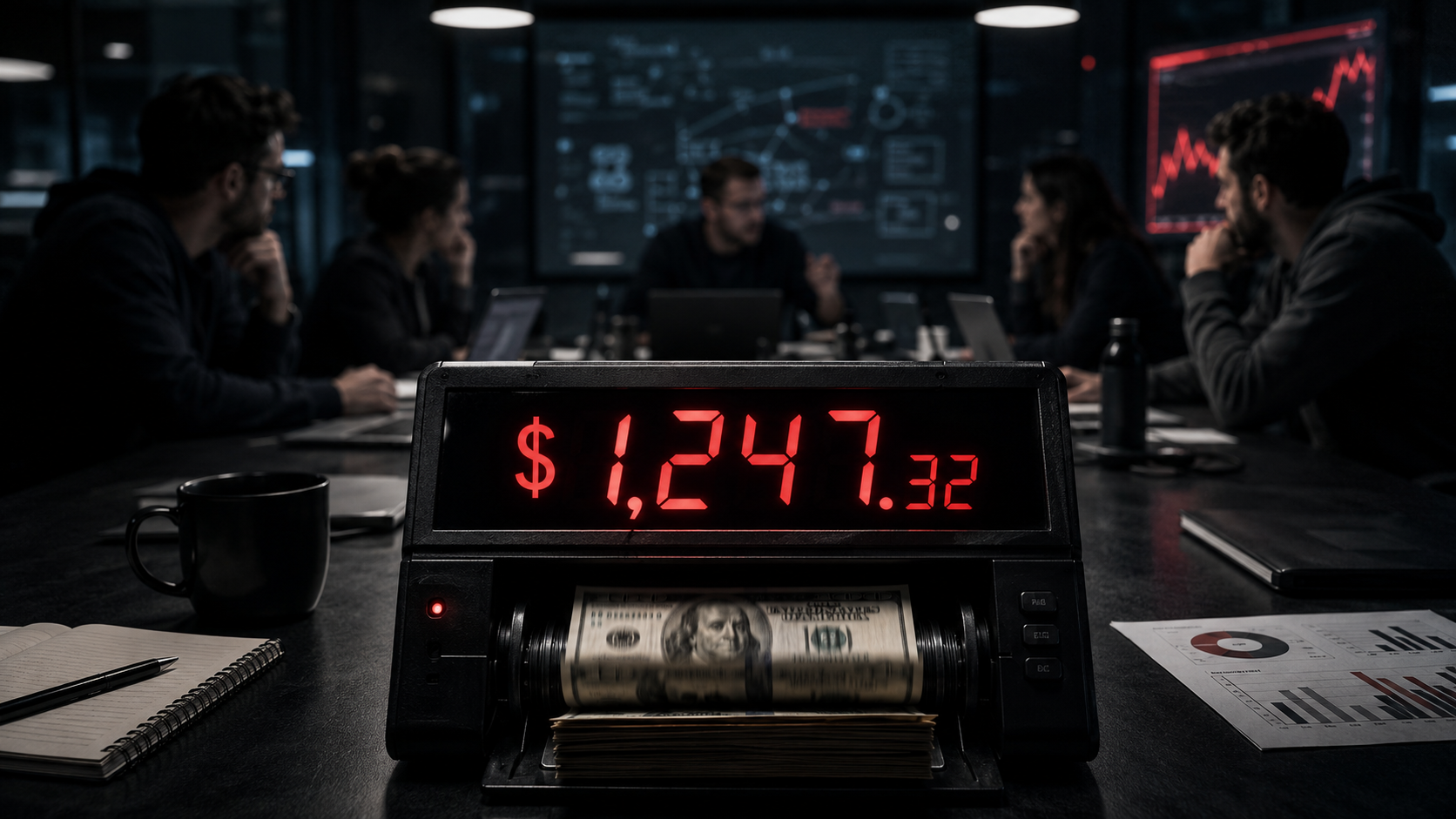
Meetings are the highest-cost line item that never appears on any budget report. A 10-person engineering team can silently burn over $60,000 a year in meeting overhead — with zero entries in the P&L.
The invisible cost hiding in your calendar
Every sprint, every quarter, engineering orgs obsess over cloud spend, licence fees, and headcount. Nobody opens a spreadsheet and asks: «What did that 90-minute cross-functional sync cost us?»
That blind spot is one of the biggest productivity leaks in modern software companies. The cost of business meetings never shows up on an invoice, yet it’s paid every single day — in engineering hours, in context-switching tax, and in the deep work that never happens.
Based on Microsoft Work Trend Index and Bain & Company data and Bain & Company data, individual contributors spend 35–50% of their working week in meetings or preparing for them. For senior engineers and engineering managers, that figure exceeds 60%. At a $120k/yr fully-loaded salary, that’s $36,000–$72,000 per person per year allocated to meetings — before a single line of code is written.
Why we keep scheduling meetings we don’t need
The over-meeting problem isn’t irrational — it’s a predictable output of the incentive structures inside most companies. Understanding the psychology is the first step to breaking the loop.
In orgs where output is hard to measure directly, attendance becomes a visibility proxy. Scheduling a meeting — and being invited to one — signals relevance. Engineers and managers who block deep-work time risk being seen as «not a team player,» regardless of what they ship.
«Cover Your Ass» dynamics drive over-invitation. Organisers add stakeholders not because their input is needed, but to distribute accountability. The result: every decision meeting has 4 decision-makers and 8 witnesses.
Recurring syncs are almost never cancelled — they’re just inherited. A meeting born during onboarding outlives the project, the team, and sometimes the product itself. Nobody kills it because nobody owns the decision to kill it.
Remote and hybrid teams over-compensate for reduced face time by scheduling more calls. The implicit belief: «if we’re not talking live, we’re not aligned.» This conflates communication bandwidth with communication quality.
None of these behaviours are malicious. They’re rational responses to broken incentive systems. The fix isn’t cultural pressure — it’s making the cost of each meeting legible at the moment the invite is sent, not in a quarterly retro.
How to calculate the true cost of a meeting
The formula is embarrassingly simple. The hard part is that almost no tooling surfaces it automatically:
Total cost = Σ (hourly cost per attendee) × duration in hours
Hourly cost ≠ gross salary ÷ working hours. You need the fully-loaded cost: employer payroll taxes, benefits, equipment amortisation, and office space. The standard multiplier ranges from 1.4× to 1.8× on top of gross salary — use 1.6× as a safe default.
Step-by-step worked example
1. List attendees and their roles
A typical backend kick-off: 1 Engineering Manager ($130k/yr), 2 Senior Engineers ($110k/yr each), 1 Product Manager ($105k/yr), 1 Staff Designer ($95k/yr).
2. Compute fully-loaded hourly rate per role
Multiply gross salary by 1.6× then divide by 1,760 working hours/year: EM → $118/h · Sr. Eng → $100/h each · PM → $95/h · Designer → $86/h.
3. Multiply by actual duration
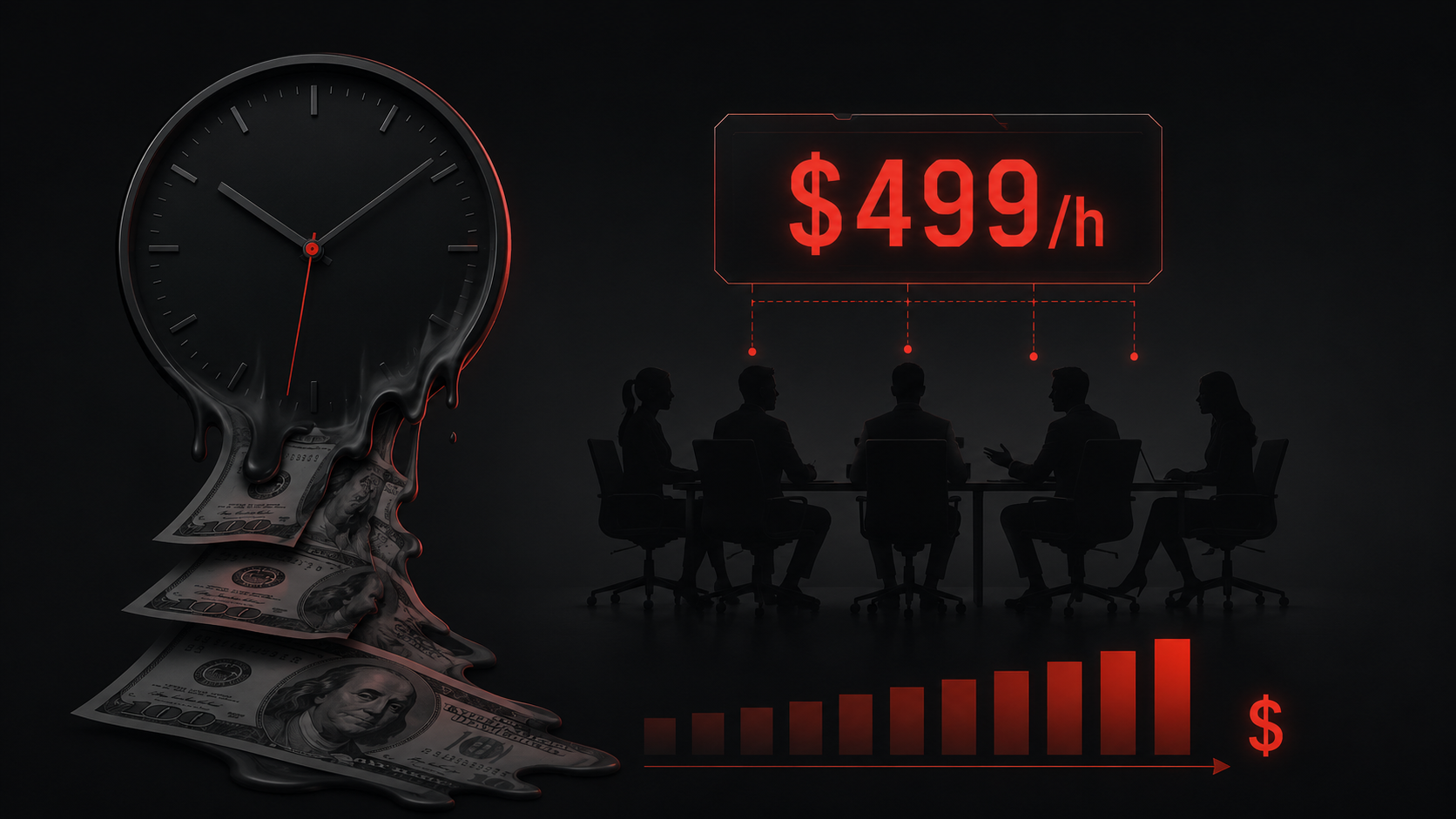
Meeting runs 75 min (1.25 h). Sum of hourly rates: 118 + 100 + 100 + 95 + 86 = $499/h × 1.25 h = $624 for that one meeting.
4. Annualise the impact
Three similar syncs per week over 48 working weeks: $624 × 3 × 48 = $89,856/yr for that single recurring pattern.
5. Layer in opportunity cost
Every meeting hour is a deep-work hour that doesn’t ship product, close pipeline, or fix tech debt. True cost is realistically 2–3× the salary burn shown above.
Meeting cost benchmarks by industry and team type
Not all industries bleed the same. The combination of average seniority, meeting frequency, and fully-loaded salary varies dramatically — and so does the annual cost per employee.
| Industry / team type | Avg meetings/week | Avg fully-loaded salary | Est. annual meeting cost/person | Severity |
|---|---|---|---|---|
| SaaS / product engineering | 8–14 | $130–160k | $45,000–$72,000 | Critical |
| Management consulting | 12–20 | $110–180k | $55,000–$95,000 | Critical |
| Enterprise IT / systems | 10–16 | $90–130k | $38,000–$62,000 | High |
| Digital marketing / growth | 6–12 | $70–100k | $22,000–$40,000 | High |
| Design / UX | 5–10 | $85–120k | $20,000–$42,000 | High |
| Customer success / support | 4–8 | $55–80k | $12,000–$24,000 | Moderate |
| Fully async remote teams | 1–3 | varies | $3,000–$10,000 | Low |
The pattern is consistent: the higher the average seniority and the more meeting-heavy the culture, the greater the delta between what the company thinks it’s spending and what it’s actually spending.
Meeting ROI by type: what actually pays off
The goal isn’t zero meetings — it’s a positive ROI on every one. Here’s how common meeting types stack up:
| Meeting type | Avg cost (5 attendees, 1 h) | ROI potential | Async replacement? |
|---|---|---|---|
| Daily stand-up (15 min) | ~$90 | High if timeboxed | Partially (Slack thread / bot) |
| Architecture decision meeting | ~$500–900 | Very high | No — needs real-time debate |
| Weekly status update | ~$300–500 | Low | Yes — Loom or written update |
| Sprint retrospective | ~$400–700 | High if tracked | Partially (async retro tools) |
| No-agenda recurring sync | ~$300–600 | Negative | Yes — cancel or convert |
The async-first playbook: how leading engineering orgs did it
Async-first doesn’t mean no meetings. It means meetings are the last resort, not the default. Several organisations have published the results of this shift — the numbers are hard to argue with.
GitLab’s entire handbook is public. Their async-first approach relies on written proposals (issues and MRs) over verbal alignment. Decisions are made in comments, not calls. GitLab reports that the average employee attends fewer than 4 synchronous meetings per week — a fraction of industry norm.
37signals (Basecamp) enforces full no-meeting days and replaced status updates with written check-ins on their own platform. In It Doesn’t Have to Be Crazy at Work, Fried and Heinemeier Hansson document how eliminating interruption-heavy culture directly correlated with shipping faster with a smaller team.
WordPress’s parent company operates across 100+ countries with almost no synchronous meetings. Communication happens through internal blogs (P2 theme). Engineers write proposals, managers comment asynchronously, and calls are reserved for relationship-building — not decision-making.
Each of these orgs built cultural norms around a simple question: «Is this worth the combined hourly rate of everyone in the room?» The teams that answer this question honestly — and have tooling that quantifies it — consistently reduce meeting load by 30–50% within 90 days.
How to roll out async-first in your team: a phased approach
| Phase | Action | Expected outcome | Timeline |
|---|---|---|---|
| 1 — Audit | Log every recurring meeting: owner, attendees, duration, stated purpose | Full visibility into current overhead | Week 1 |
| 2 — Instrument | Deploy a real-time cost counter to all meetings | Teams self-regulate within days | Week 1–2 |
| 3 — Eliminate | Cancel any recurring with no agenda and no action items in last 30 days | 20–30% immediate reduction in meeting hours | Week 2–3 |
| 4 — Convert | Replace status updates and FYI syncs with Loom, Notion, or Linear comments | 2–4 h/week returned to every IC | Week 3–6 |
| 5 — Protect | Block deep-work windows (no-meeting mornings or full days) | Measurable increase in shipping velocity | Week 4–8 |
How to cut meeting costs without losing alignment
Fewer meetings doesn’t mean worse communication — it means higher-bandwidth communication. These tactics have the highest documented impact:
| Tactic | Estimated impact | Difficulty |
|---|---|---|
| Show real-time cost during the meeting | 20–35% reduction in unnecessary meetings | Low |
| Require a written agenda before scheduling | 30% reduction in average duration | Low |
| Replace status updates with async docs / Loom | Save 2–4 h/week per engineer | Medium |
| Cap attendees to decision-makers only | 40–60% reduction in direct cost | Low |
| Visible countdown timer on screen | 25% reduction in overrun time | Low |
See exactly what your meetings are costing you — right now
Start a meeting, add your team’s roles, and watch the real-time cost counter run. No integrations required. No credit card. Just the number your P&L has been hiding.
Calculate my meeting cost →Tooling: how to instrument your meetings
The fastest way to change team behaviour isn’t a process doc or an all-hands. It’s making the cost visible at the moment it’s being incurred.
Tools that display a live, running total — in dollars or euros — as the meeting progresses, calculated from each attendee’s role and salary band. The psychological impact is immediate and lasting: teams self-regulate without any top-down mandate.
Best-in-class solutions read the invite list, map attendees to salary bands or role presets, and show a projected cost before the meeting starts — giving the organiser a chance to trim the guest list.
Weekly or monthly reports that surface which teams, managers, or meeting types are burning the most budget — so engineering leads can make data-driven decisions about where to cut and what to protect.
Conclusion
The cost of business meetings is one of the largest unmanaged line items in any software organisation. It doesn’t appear on any balance sheet, but it’s paid every day in the form of engineering hours and shipped features that never were.
The good news: this is one of the most tractable problems in org design. You don’t need a restructure, a new methodology, or a culture overhaul. You need two things — visibility into what meetings actually cost, and a lightweight async playbook that gives people a credible alternative. The rest follows naturally.
FAQ: Cost of business meetings
What is the average cost of a business meeting?
It depends on headcount and seniority. A 5-person engineering meeting running 1 hour, with a fully-loaded average of $100/h per person, costs $500. If that meeting recurs weekly, the annual bill exceeds $24,000 — for one recurring invite.
How do you calculate the cost of a meeting?
Sum the fully-loaded hourly rate of every attendee (gross salary × 1.4–1.8 employer multiplier, divided by ~1,760 working hours/yr), then multiply by the actual duration. A real-time meeting cost calculator automates this per role.
What percentage of work time is lost to meetings?
Industry benchmarks put individual contributors at 35–50% of their working week in meetings or meeting prep. Engineering managers and directors frequently exceed 60%. The majority of that time is in recurring meetings with no agenda.
What tools can calculate meeting costs automatically?
Real-time meeting cost calculators integrate with Google Calendar or Outlook, assign salary bands to each attendee role, and display a live cost counter during the meeting. Advanced versions generate per-team spend reports weekly.
Is it worth reducing meetings in an engineering team?
Yes — measurably so. Replacing low-ROI syncs with async alternatives consistently returns 2–4 hours per engineer per week. At senior compensation levels, that translates directly into shipping velocity and reduced burnout.
How do async-first companies like GitLab manage without daily meetings?
They replace verbal alignment with written artefacts: issues, MRs, and internal docs serve as the communication layer. Decisions are made in comments, not calls. Synchronous meetings are reserved for high-bandwidth conversations that genuinely can’t happen any other way.